


What FIPS 201 Means for Your RFID Blocking Sleeve (And Why Most Travel Sleeves Don't Meet the Standard)
- Alpine Rivers® founder
- May 23
- 11 min read
The airport moment that started this whole product
Heathrow Terminal 5, March 2015. I am queuing for a coffee, contactless card tapped, transaction approved, no signature. The whole exchange takes less than a second. The convenience is the point.
Three steps later I think about the same physics from the other side. A card that pays without touching a terminal is a card that broadcasts. If a payment terminal can read it from four inches away, so can anything else holding a reader at the same frequency. That was the moment Alpine Rivers® became a company.
We launched with one belief: the sleeve in your pocket should not be marketing fluff. It should meet a real shielding standard, the kind a government uses to protect its own credentials, not a sticker on a box.
This article explains what that standard actually is, why it matters now in 2026 more than it did when we started in 2015, and how you can tell whether the sleeve you already own is doing the job.
What is FIPS 201, and why does it matter for a card sleeve?
FIPS 201 is the US federal standard for shielding sleeves that protect government Personal Identity Verification (PIV) cards and e-passports. The full name is Federal Information Processing Standard Publication 201, administered by the National Institute of Standards and Technology (NIST). The General Services Administration (GSA) maintains the Approved Products List (APL) of sleeves that have passed independent shielding tests.
A sleeve on the GSA APL has been proven to attenuate the 13.56 MHz signal used by contactless credit cards, e-passports, transit cards, hotel keys, and most modern access badges. Attenuation, in this context, is the engineering word for "the sleeve makes the broadcast quiet enough that a nearby reader cannot pick it up while the card is inside."
In 2016 our RFID Blocking Sleeves achieved FIPS 201 US government approval (GSA APL #1424). That listing is the public record that an independent third-party lab tested our sleeves against the same standard the US federal government uses for its own PIV credentials, and that we passed.
That is the shielding standard we built to from the beginning. The rest of the Alpine Rivers® range carries the same idea forward in its own way. Our RFID Blocking Money Belt and RFID Blocking Neck Wallet are RFID-blocking by design, with three layers of shielding material built into the body of the belt and the pouch themselves. They also ship with bonus FIPS 201-listed RFID Blocking Sleeves so cards stay shielded the moment you take them out for everyday use.
How does RFID skimming actually happen?
Three conditions have to line up:
Your card has a contactless chip. Almost every credit card issued in the US, UK, and EU since 2017 does. So does every US passport issued after October 2006. So do most transit cards, hotel keys, employee badges, and gym tags.
The chip is awake. It does not need a battery. The reader supplies the energy. As long as the card is within four inches of a powered reader broadcasting on 13.56 MHz, the chip responds.
The reader is hostile. Most readers in the world are legitimate. Some are not. A hostile reader is just a normal reader hidden in a bag, a coat pocket, a backpack, or a market stall, configured to log the card data instead of process a transaction.
This is the part where most people stop reading because it sounds theoretical. It is not. Industry researchers have demonstrated skimming attacks at distances up to a metre with off-the-shelf hardware costing under $400. The attack is silent. The card does not buzz. The phone does not warn you. The first sign anything happened is on your statement, often weeks later.
A sleeve that meets FIPS 201 fully encloses the chip in a Faraday cage. The metallic laminate absorbs the reader's energy before the chip can respond. The chip stays asleep. The broadcast never happens. No data is captured. No statement surprise.
What is a Faraday cage, and how does a paper-thin sleeve become one?
A Faraday cage is any enclosure that blocks radio-frequency energy. The classic example is a microwave oven door. The mesh you see is sized to block the 2.45 GHz microwave radiation inside while still letting visible light through so you can watch your popcorn.
For 13.56 MHz (the contactless card frequency) the wavelength is roughly 22 metres. You do not need a mesh. You need a continuous conductive surface around the card on all six sides.
Our four-layer laminate stack is engineered to do this with paper-substrate construction:
An outer printed paper layer for finish and durability
A protective inner paper liner to keep the card surface clean and prevent oxidation
The result is a sleeve that adds two grams of weight and 0.3 millimetres of thickness to your wallet, blocks the broadcast while inserted, and lets the card work normally the second you slide it out. Free. Secure. Present.
Why do most off-the-shelf sleeves fail the standard?
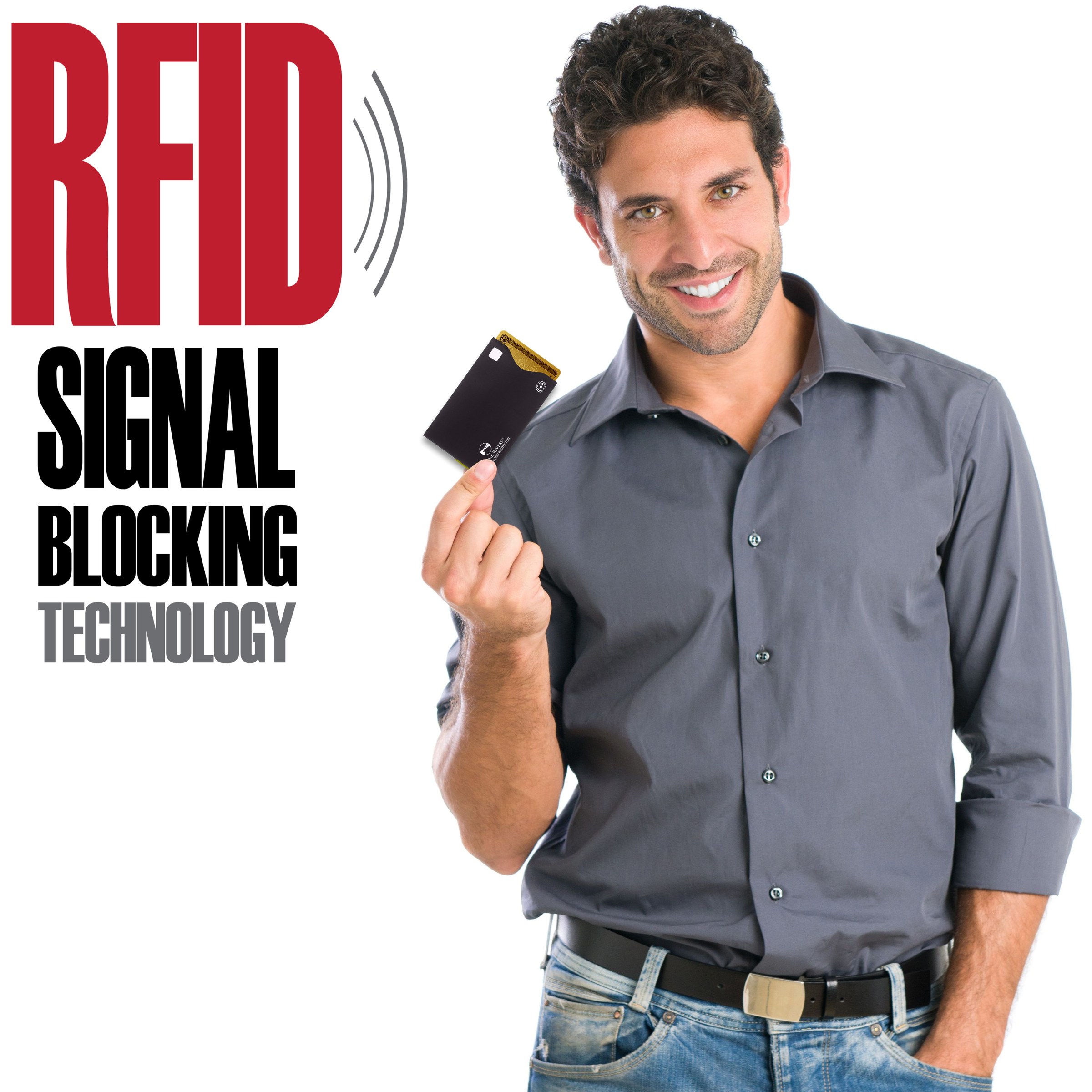
Three common shortcuts:
Single-layer construction. A printed paper sleeve with one thin metallic film looks identical to a four-layer sleeve from the outside. It costs a fraction to produce. It attenuates a fraction of the signal. It will block weak readers at long range and fail completely at the four-inch range where actual skimming happens.
Open seam at the top edge. A sleeve that closes only on three sides leaks the broadcast through the open edge. Top-loader and side-loader sleeves both work if the loaded edge folds over the card completely. A loose edge does not.
No independent testing. The vast majority of "RFID blocking" sleeves on Amazon, Etsy, and AliExpress have never been tested by an independent lab. The label is a marketing claim, not a verification. The GSA APL is searchable. If the sleeve maker cannot point to a listing number, the claim is unverified.
We carry what we make. We test fit and comfort. We pull random samples from every production run for independent batch inspection. That has been true since launch in 2015 and it has never stopped.
What cards actually need the sleeve?
Card type | Frequency | Contactless? | Sleeve recommended |
Tap-to-pay credit and debit cards | 13.56 MHz | Yes | Yes |
E-passport (US, UK, EU, AU, NZ, JP, KR) | 13.56 MHz | Yes | Yes |
Transit cards (Oyster, MetroCard, SmarTrip, Clipper, Suica, etc.) | 13.56 MHz | Yes | Yes |
Hotel room key cards (most modern brands) | 13.56 MHz | Yes | Optional |
Employee access badges and gym tags | Usually 125 kHz or 13.56 MHz | Yes | Yes (especially for executive badges) |
Driver's licenses with embedded chip (where applicable) | 13.56 MHz | Yes | Yes |
Old magnetic stripe cards (chip and PIN only) | None | No | Not required |
If your card taps to pay, it is covered. The same is true for any RFID-enabled travel document or membership tag. The sleeve does not interfere with the chip when the card is removed for normal use.
How can you test the sleeve you already own?
Two field tests:
Test 1. The transit gate. Slide a transit card into the sleeve. Approach the gate the way you normally would. If the gate opens, the sleeve is leaking. A sleeve that meets the FIPS 201 attenuation level will not open the gate while the card is inside. The test costs you one tap on the gate after the test fails. Reset by removing the card from the sleeve.
Test 2. The contactless terminal. Hold the sleeved card against a contactless terminal in the position you would use to pay. The terminal should not register a tap, beep, or show a pending transaction. If it does, the sleeve is not shielding effectively at terminal range.
Both tests are honest. Both tests work for any sleeve, including ours. If your sleeve passes both, keep it. If it fails either, replace it with one that has independent shielding test data.
Where does this matter in everyday life?
When people picture card skimming they usually picture a hooded figure in an airport. The truth is more boring and more common. Anywhere a stranger can stand within four inches of your wallet for a few seconds is enough. That covers most of an average week.
A useful way to think about it: the risk goes up when crowds, queues, and standing still come together. Once you start listing the places that hit all three, the list gets long fast.
Scenario | Why your card is exposed | What the sleeve does about it |
Airport security queues | You stand still in a tight line, wallet often near a pocket exterior or in a bin. | Card stays asleep in the sleeve from kerbside drop-off to gate. |
Train station concourses and platforms | Strangers pressed against you waiting, plus walking past on either side. | Reader cannot get a clean read through the laminate. |
Subway and metro platforms | Same density, plus a tap-in turnstile that has trained you to keep the card near the surface of your bag or pocket. | Sleeve stops the card responding until you take it out for the gate. |
Cafés and coffee shop queues | You wait at the till with the wallet already in hand or on the counter. | No incidental read while you wait your turn. |
Restaurant tables and outdoor terraces | Wallet sits on the table, often for the entire meal. Passers-by and adjacent diners come close. | Card in the sleeve does not broadcast even while sitting in the open. |
Self-checkout kiosks (grocery, pharmacy, big-box) | You move between the bag-drop, the scanner, the screen, the card reader. The wallet rarely leaves the bag area. | Card only wakes when you remove it and tap. |
Tap-to-pay vending machines and kiosks | The reader is sometimes higher-powered than retail readers and the queue can be tight. | Sleeve blocks the broadcast until the card is out. |
Drive-through windows | You hand a card across, but the wallet sits next to the driver's hip for the wait. | Sleeve covers the wait, not the tap. |
Festival, concert, and stadium entry gates | Bodies in every direction, often in low light, often standing for ten minutes or more. | Card stays sleeved through the gate, taps for entry only when you choose. |
Crowded ride-share pickup zones | You stand by a kerb checking the app while strangers pass close on both sides. | Wallet in pocket or bag stays inert. |
Open-air markets and souks | Vendors lean in, neighbouring stalls are inches away, the geometry favours a reader hidden in a bag. | Card is invisible to readers until you choose to pay. |
Hotel lobbies during check-in | You queue, then stand at the desk with the wallet open. | Card stays sleeved until you hand it over. |
ATMs in tourist districts | You stop, you stand, you fumble. People line up close behind. | Sleeve protects every card except the one you are using. |
Tourist information and ticket kiosks | Tight queue lines, often in transit hubs where readers are everywhere. | Same as above. |
None of these are exotic places. They are the normal week of anyone who travels, commutes, eats out, or buys a coffee. The sleeve does not change how you move through any of them. It just changes whether your card data goes home with you or with someone else.
Frequently asked questions
Does the sleeve interfere with normal payment?
No. The sleeve only attenuates the broadcast while the card is fully inside. Remove the card and tap normally. The chip resumes operation instantly.
Will the sleeve damage the card?
No. The four-layer laminate is non-abrasive on both faces. The card slides in and out cleanly. The sleeve does not heat, scratch, or magnetize the card.
Do I need a separate sleeve for my passport?
Yes. Passport sleeves are sized to fit all current US, UK, EU, AU, NZ, JP and KR passports, including the 52-page versions. Card sleeves are sized for ID-1 cards (the standard credit card footprint). Mixing them is uncomfortable and the loaded edge will not seal properly.
How long does a sleeve last?
Years with daily use. The laminate does not degrade with normal handling. Replace if the inner liner tears or if you can see metallic foil through the paper.
Is the FIPS 201 listing transferable to your other products?
The FIPS 201 GSA APL #1424 listing covers our card and passport sleeves specifically. Our RFID Blocking Money Belt and RFID Blocking Neck Wallet are RFID-blocking in their own right, with three layers of shielding material built into the body of each unit. The card and passport sleeves carry the FIPS 201 listing on their own. Every belt and every wallet also ships with bonus RFID Blocking Sleeves so the same shielding follows your cards into a pocket, a bag, or a wallet when you take them out for everyday use. Together that is what we mean by Security Beyond Travel™.
Where can I see the GSA APL listing?
Search the General Services Administration Approved Products List for FIPS 201 Shielding Sleeves. Alpine Rivers® is listed under GSA APL #1424 with the 2016 approval date.
Why does the year matter?
The shielding standard we built to is the one in force at the time of certification. Newer certifications are not stricter. The 13.56 MHz attenuation requirement has not changed. A 2016 GSA APL listing carries the same shielding promise today.
What is the difference between top-loader and side-loader sleeves?
The loaded edge. Top-loader sleeves close at the long edge above the card. Side-loader sleeves close at the short edge to the side of the card. Both work when the seam is sealed correctly. Personal preference and wallet layout decide which is easier to handle.
What the Alpine Rivers® range looks like today
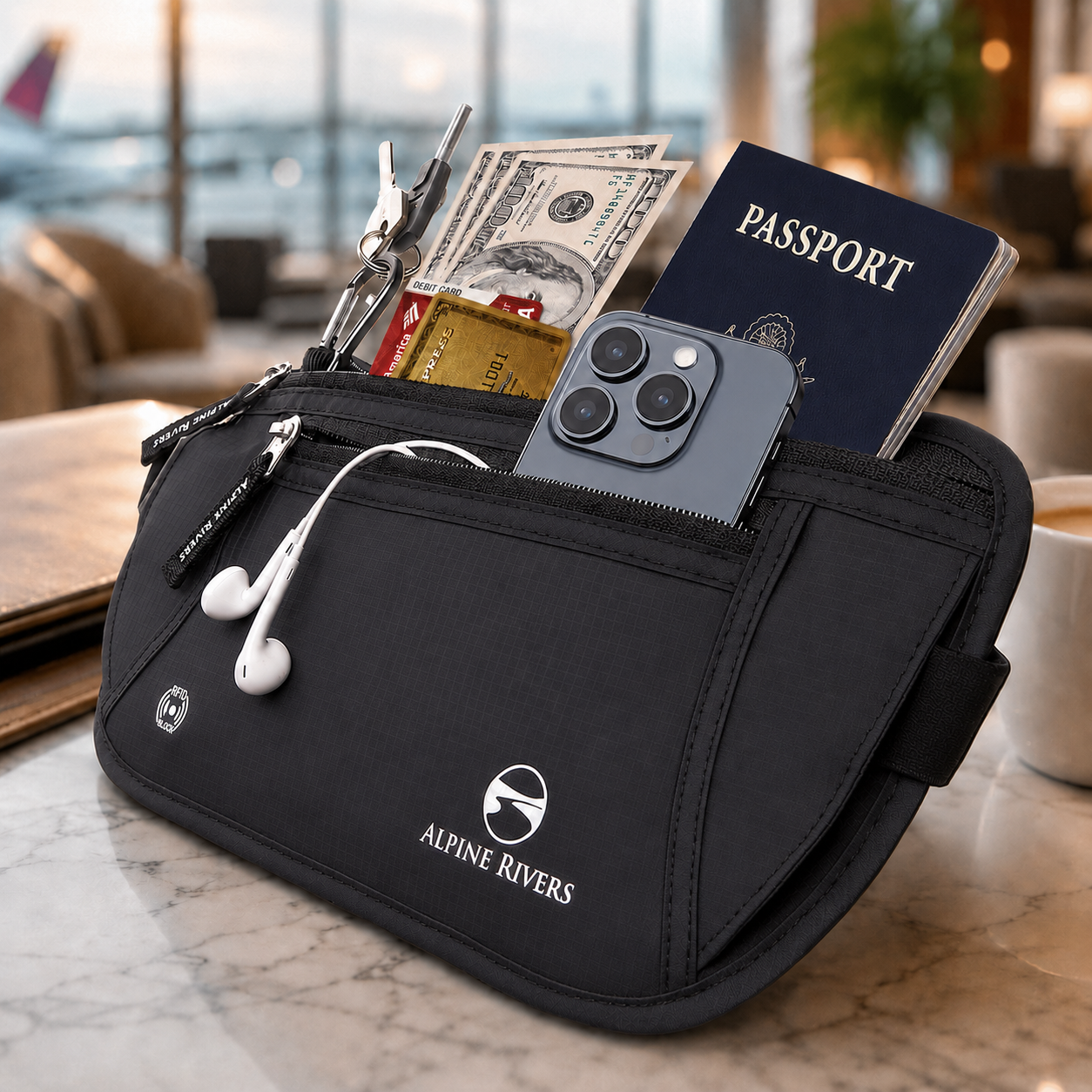
The shielding standard we set in 2015 runs through every product we ship. The whole range is on this single page so you can see how the pieces fit together.
Product | Form factor | How the FIPS 201 shielding shows up |
RFID Blocking Sleeves (card) | Slim ID-1 sleeves sized for credit cards. Numbered ID edges or a Write-On ID Box so the right card finds your hand without thinking. Sold as packs in mixed top-loader and side-loader formats. | The sleeves themselves. GSA APL #1424, the listing that started the brand. |
RFID Blocking Sleeves (passport) | Passport-sized sleeves cut to fit every current US, UK, EU, AU, NZ, JP and KR passport including the 52-page versions. Same laminate stack as the card sleeves. | The sleeves themselves, sized for ID-3 documents. |
RFID Blocking Money Belt | Slim under-clothing waist belt. Two front zippered pockets, hidden rear mesh pocket, original YKK zippers stamped both sides. Sized for modern smartphones. | The belt body itself is RFID-blocking — three layers of shielding material built into the construction. Bonus RFID Blocking Sleeves are included with every belt so the same shielding follows your cards when you take them out for everyday use. |
RFID Blocking Neck Wallet | Travel pouch worn four ways: around the neck, cross-body, under clothing, or clipped to a belt loop. Three front zippered pockets, soft rear mesh pocket for phone or boarding pass. | The pouch body itself is RFID-blocking — three layers of shielding material built into the construction. Bonus RFID Blocking Sleeves are included with every wallet for use outside the pouch. |
That is the whole story of the brand in one table. Card sleeves are the original product and still the foundation. They carry the FIPS 201 GSA APL #1424 listing on their own. Passport sleeves came from the same laminate. The Money Belt and the Neck Wallet are RFID-blocking by design, with three layers of shielding material built into the body of each unit. Each one also ships with bonus RFID Blocking Sleeves so cards stay shielded even when they leave the belt or the wallet for everyday use. Every production run, every variant, goes through independent batch inspection. That has been true since 2015 and it has never stopped.
If you have a question about RFID blocking that this article did not answer, contact us at info@alpine-rivers.com. We answer every message.
About the author
This post is by the founder of Alpine Rivers®. The brand was founded in 2015, designed in Houston, Texas, and headquartered in London. Alpine Rivers® operates the official Alpine Rivers® Brand Store on Amazon with over 19,000 verified reviews across the product range at 4.7 stars. The founder writes about RFID shielding, travel-grade product engineering, and the gap between marketing claims and independent testing.
Alpine Rivers® and the Alpine Rivers® logo are registered trademarks of Alpine Rivers® (USPTO Reg. 5,122,373 and 6,325,028). PolyShield™ and Security Beyond Travel™ are trademarks of Alpine Rivers®.
California residents: see our Proposition 65 Warning.